Can Your Business Run Without You? The Owner Dependency Question Every Canadian Business Owner Must Answer
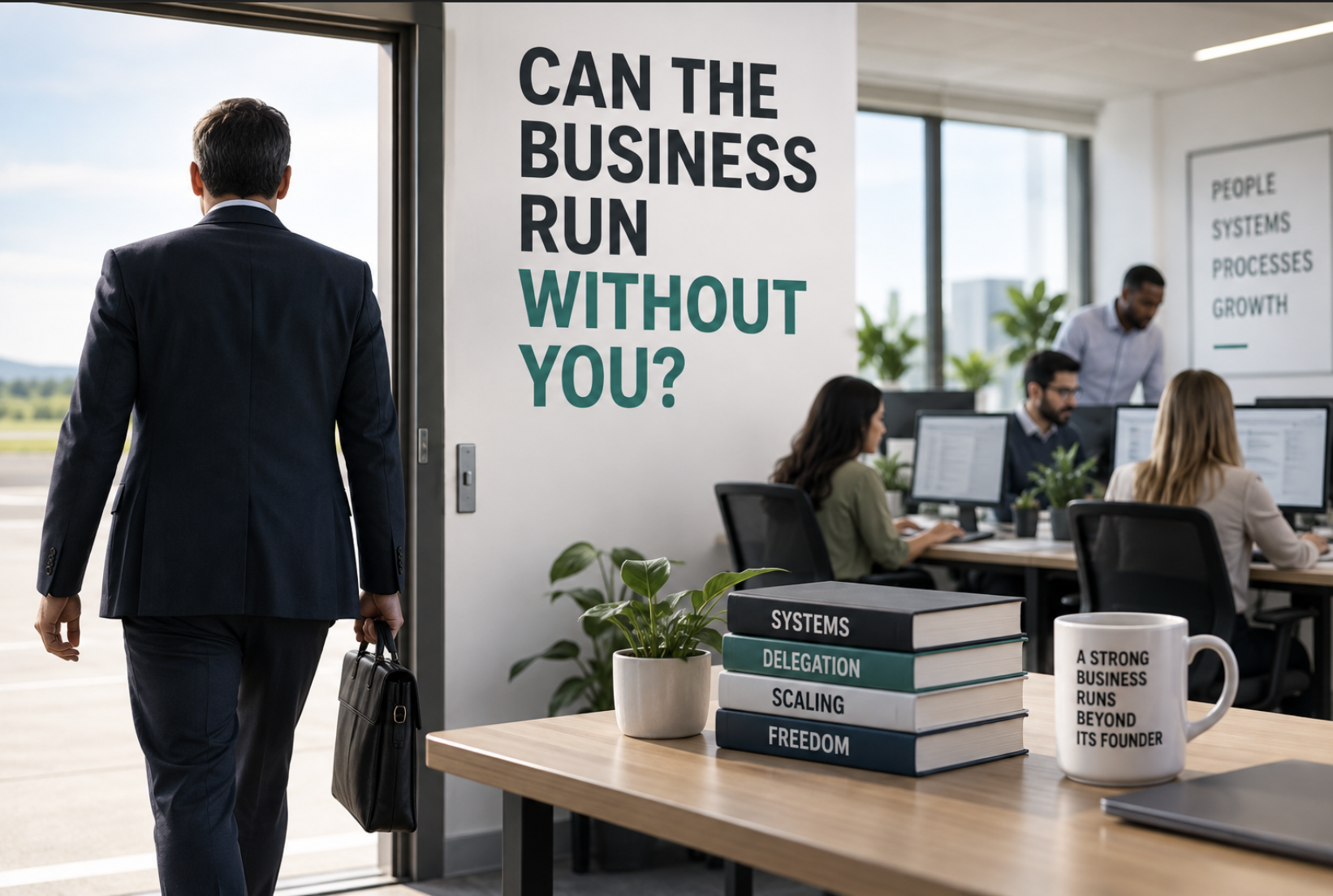
You built a business by being indispensable. Now that same strength is the ceiling — on your freedom, your options, and what someone will pay for what you've built.
Ask a business owner whether their company could run without them for a month, and the answer tells you more than a year of financial statements. Most pause. Some laugh. A few say yes — and when you dig, it turns out they mean the doors would stay open, not that the business would actually run.
That gap — between a business that survives the owner's absence and one that functions without them — is owner dependency. And it's the single constraint that most owner-operators never see coming, because it arrives disguised as success.
You built the business by being the one who could solve anything. You're the best salesperson, the closer on difficult jobs, the person clients call when something goes sideways. That was exactly the right way to build it. The problem is that the strength that got you here becomes the ceiling — on your time, your options, and eventually on what someone will pay to own what you've built.
What owner dependency actually is
Owner dependency is the degree to which a business's revenue, operations, decisions or key relationships rest on a single person. It shows up everywhere: the owner is the primary salesperson, the final decision on every quote, the person suppliers call, the technical expert who solves the hard problems, the one holding client relationships that took years to build.
In the early years, this is unavoidable. The founder is the business — its quality control, its reputation, its institutional knowledge. The issue is not that the owner is valuable. The issue is when too much of that value isn't transferable.
Most owners don't notice the line being crossed. What starts as "nobody else can do this as well as I can" becomes "nobody else can do this at all." And by the time you're thinking about an exit, or growth, or simply getting your life back, the dependency has been baked in for years.
Why this matters in Canada right now
This isn't an abstract problem. Over three-quarters of Canadian small business owners plan to exit their business within the next decade, according to the Canadian Federation of Independent Business — a wave representing over $2 trillion in business assets potentially changing hands. But the same research consistently finds that only 9 per cent of Canadian businesses have a formalized succession plan in place.
The math is uncomfortable. When a large number of businesses come to market at once and few are prepared, buyers have their pick — and unprepared, owner-dependent businesses are the ones that sell at a discount, take years to move, or don't sell at all.
And nearly 39 per cent of small business owners say the business is too reliant on them for day-to-day operations, which is the problem stated plainly: they know it, but they haven't fixed it, because fixing it is a years-long project that nobody started.
How buyers see it
A buyer isn't paying you for the decades of work. They're paying for the earnings the business will generate after the sale — and discounting that by the risk that those earnings walk out the door when you do.
So they ask questions that feel uncomfortable, because they're designed to find the dependency:
- If you left for ninety days, what would break?
- Who closes the deals in your absence?
- Can someone else price a job, or does it all run through you?
- Where is your process documentation — not just what's written down, but what could a replacement actually learn from?
- What happens to your top three customer relationships when you're gone?
These aren't theoretical. Every one of them is asked in diligence, because buyers don't trust what an owner says about dependency — they test it. They interview the team without the owner present. They look for written systems. They ask customers whether they're loyal to the company or the person.
A business where most of the answers run back to the owner is worth materially less than one where they don't, even if the revenue is identical. Not because the buyer is being difficult — because they're pricing the risk that the business won't produce what it used to once the owner is gone.
Where dependency hides
It's rarely just one thing. It's the accumulation of ordinary decisions, each of which felt sensible at the time:
Revenue dependency
The owner is still the primary business development person. Referrals come through personal networks. Customer relationships are maintained by the owner, not the account manager — if there is one. A buyer looks at this and sees revenue that evaporates when the owner exits.
Operational dependency
Pricing isn't documented; the owner quotes from experience. Job scheduling runs through the owner. Quality control is the owner walking the site. Supplier relationships and credit terms are personal. Crisis management — the job that's behind, the unhappy client, the crew conflict — goes to the owner, because nobody else has the authority or the judgment.
Knowledge dependency
The estimating method lives in the owner's head. The margin targets aren't written down, they're felt. The owner knows which customers pay slowly and which jobs lose money, but the team doesn't. How the work actually gets done exists as institutional knowledge rather than process documentation.
None of these are catastrophic alone. Together, they mean the business is the owner — and a business that is its owner is not an asset someone else can own. It's a job the buyer would have to step into, with no manual and no guarantee it works without the original operator.
What it costs you — before you ever try to sell
The exit discount is what gets talked about, but the operational cost arrives long before that. Owner-dependent businesses don't scale, because growth requires the owner to do more of what only the owner can do — which has a hard ceiling.
They don't survive disruption well. If the owner is unavailable — illness, injury, or simply burnout — the business stalls. Vacations get interrupted. Days off don't exist, or they do and the inbox proves it. The owner becomes the bottleneck to everything, which is another way of saying the owner has built a high-paying job rather than a business.
And the owner never gets to step back into strategy, because they're too busy executing. The result is a business that plateaus not because the market won't support growth, but because the operator is at capacity and there's no path to add leverage.
How to tell if you've built an asset or a job
Ask yourself these, honestly:
- Could you take a full month off without being contacted? Not could the doors stay open — could the business actually operate, quote, close and deliver work, and collect payment, without you?
- If a key employee quit tomorrow, would you have to step back into their role? Or could someone else on the team absorb it because the work is documented and they've been cross-trained?
- Can someone other than you explain to a stranger how the business makes money? Not just revenue and cost of sales — how jobs are priced, what margin is targeted, which service lines are profitable, and why.
- If you were hit by a bus, could the business be sold within six months? Not at a distressed price — at fair value, to a buyer who isn't taking on massive transition risk.
- Are your top three customer relationships transferable? Would they stay if someone else owned the company, or are they staying because of you?
If the answer to most of those is "no" or "probably not," the business is dependent. Which does not mean it's failing — it means it's structured around you, and that structure becomes the constraint the moment you try to do anything that requires the business to work without you.
What makes a business genuinely transferable
The goal is not to make yourself irrelevant. It's to make yourself replaceable — which is a different thing. You can still be the best person for a role. But the role needs to be defined, documented, and executable by someone else if you choose to step back.
A transferable business has:
- Documented systems. How work gets estimated, scheduled, delivered and invoiced. How quality is checked. How hiring happens. Not a policies-and-procedures manual that nobody reads — a set of instructions that a competent person could follow to produce a consistent result.
- Distributed knowledge. Pricing methodology is written and teachable. Job costing exists and is reviewed. Financial performance is visible to the people who need to act on it, not locked in the owner's desk.
- Management capacity. Someone other than the owner can make operational decisions and be accountable for them. This does not mean a full C-suite — it means one capable person who owns a function and runs it without needing the owner's approval on everything.
- Customer relationships that belong to the company. Clients know more than one person. Contracts are with the business, not the individual. Renewals and upsells happen through an account manager or a process, not because the owner calls in a favour.
- Financial clarity. Clean books, ideally reviewed. Normalized earnings are understood and defensible. The owner can explain, with evidence, what the business earns when one-time costs and personal expenses are stripped out.
None of this is exotic. It's basic operational maturity. But most owner-operators skip it, because they're good enough at the work that they never had to build the scaffolding around them — until the day they need it and it takes two years to install.
The timeline nobody wants to hear
Meaningfully reducing owner dependency takes 12 to 24 months, sometimes longer in businesses with deep founder-led customer relationships. It is not a weekend project. It is not a consultant engagement that runs for six weeks and hands you a binder.
It is a deliberate, staged process: document what's in your head, hire someone capable and give them real authority, transfer customer relationships one at a time with the owner still around to de-risk it, prove the business runs without you by actually stepping back for a month and watching what happens.
Buyers can tell the difference between dependency that has been genuinely reduced and dependency that was papered over three months before a sale. The former shows up as confidence in diligence. The latter shows up as questions the seller can't answer and terms that tie the owner to an earnout because the buyer doesn't believe the earnings survive the exit.
So the time to start is not when you've decided to sell. It's when you're tired of being the bottleneck, or you want your weekends back, or you see the ceiling coming and you realize the business has to change shape if it's going to grow past where you are now.
The real question
This is not about preparing for a sale, though that's when it matters most visibly. It's about whether you've built something that gives you options — to grow it, to step back from it, to sell it, to bring in a partner, to take three weeks off without everything unraveling.
Owner dependency is the difference between owning a business and owning a job. The job might pay well. It might be deeply satisfying. But it owns you back, and it's worth less to anyone else, because they'd be buying the same constraint.
The owners who get the strongest exit — the best terms, the cleanest process, the price that reflects what they built — are the ones who started this work years before they planned to leave. Not because they were smarter. Because they got tired of being the single point of failure, and they built a business that could run without them long before anybody asked whether it could.
Want to know where your business sits? The Exit Value Assessment is a structured look at the six factors that move what a business is worth — including owner dependency. It's free, takes about ten minutes, and you'll have a clearer picture of where the gaps are and what to fix first.
Sources
- Source: Canadian Federation of Independent Business (CFIB) — retrieved September 7, 2026“Over $2 trillion in business assets could change hands within the next decade as over three-quarters (76%) of small business owners are planning to exit their business, according to a new report by the Canadian Federation of Independent Business (CFIB).”
- Source: Canadian Federation of Independent Business (CFIB) — retrieved September 7, 2026“However, only one in 10 business owners (9%) have a formal business succession plan in place.”
- Source: Canadian Federation of Independent Business (CFIB) — retrieved September 7, 2026“Nearly half (43%) of owners are struggling to measure the value of their business, while 39% say the business is too reliant on them for day-to-day operations.”
- Source: CIBC — retrieved September 7, 2026“There is growing concern that only 9 per cent of Canadian businesses have a formalized succession plan in place.”