Why Stabilizing Your Business Before a Sale Matters More Than Scaling It
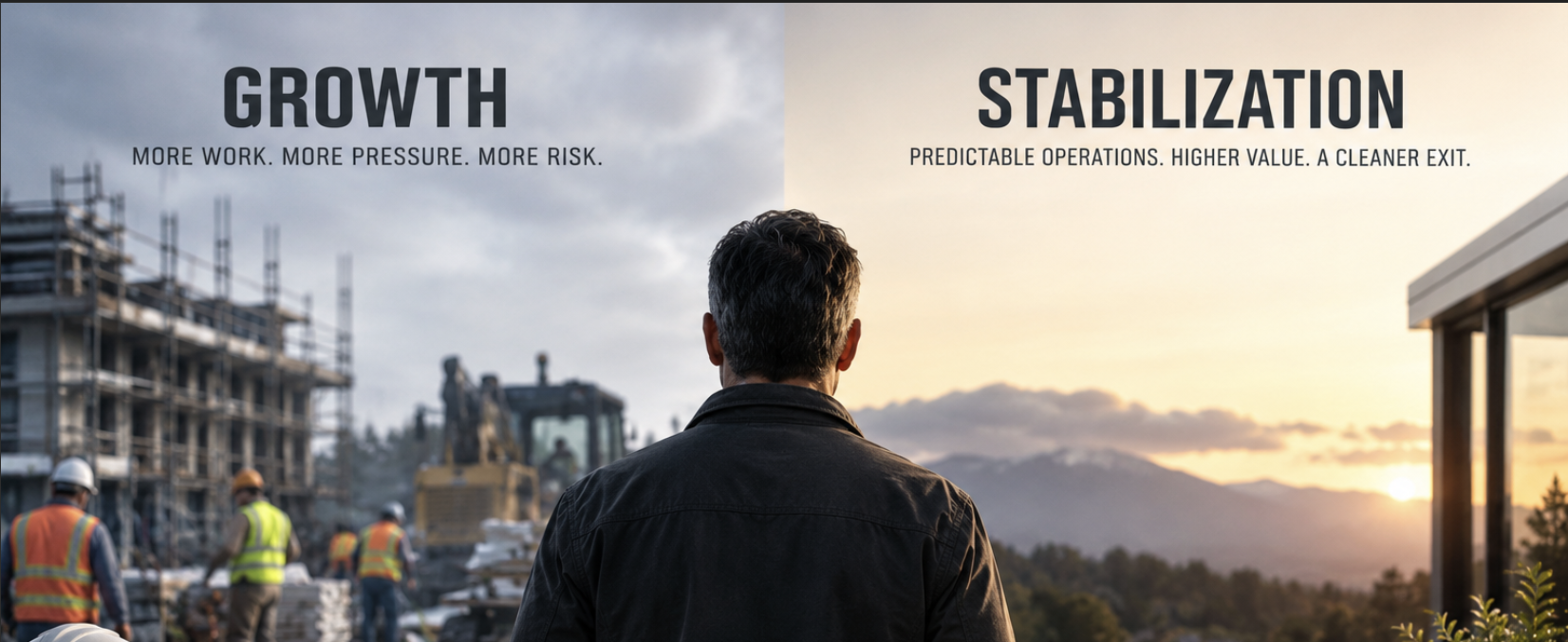
Buyers don't pay for potential. They pay for predictable, transferable operations—and that's not what rapid growth gives them.
Most owners planning an exit assume the path to a better sale is straightforward: grow revenue as fast as possible in the years before market. The logic seems obvious—a bigger business is worth more, so push for the largest top line you can before anyone sees the financials.
That instinct costs more deals, and more value, than almost any other pre-sale decision. Because buyers don't pay for potential. They pay for predictable, transferable operations that will keep producing after the current owner is gone—and rapid growth in the final stretch before a sale usually undermines exactly that.
The difference between stabilizing a business and scaling it matters more in the exit context than anywhere else, and most owners get it backwards.
What scaling actually does to a business
Scaling means adding revenue without adding the same level of resources—through automation, documented systems, and operational leverage. When done at the right time, it's how a business compounds value and grows efficiently.
But timing is everything. Scaling is valuable when the business has already proven its model, built its systems, and has predictable cash flow. It's destructive when those foundations don't exist yet—and for most owner-operated businesses preparing for exit, those foundations are exactly what's missing.
Here's what rapid revenue growth in the final 12 to 24 months before a planned sale typically produces:
- Thin or negative cash flow, because growth eats working capital faster than profit arrives
- Strained operational capacity—jobs delivered late, quality slipping, crews stretched
- Higher owner involvement, not lower, because the owner is firefighting the problems growth creates
- Inconsistent financial results across periods, which buyers read as unpredictable rather than ambitious
- New hires who haven't been there long enough to matter in a transition
Every one of those reads as risk to a buyer. And risk moves the multiple down more than revenue moves it up.
What stabilization looks like, and why buyers pay for it
Stabilization is not stagnation. It's the deliberate work of making operations predictable, documented, and transferable. It's fixing the things that would break if the owner stepped away, rather than chasing the things that would look good on a capability statement.
A stabilized business has:
- Consistent revenue and margin across comparable periods—buyers can model future performance from trailing results
- Documented processes for quoting, project delivery, hiring, and quality control
- A management layer or key employees with real authority, not just tasks delegated to them
- Customer and supplier relationships that are institutional, not personal to the owner
- Clean financial statements with no one-time adjustments that need explaining
- Predictable cash conversion—revenue becomes cash at a known rate
None of that happens in the three months before a listing. It happens over 18 to 24 months of unglamorous operational work—the kind that doesn't generate a LinkedIn post but does survive a quality of earnings review.
This is where the Business Readiness Diagnostic becomes valuable. It's built specifically to measure the dimensions buyers scrutinize—owner dependency, financial quality, customer concentration, transferability, operational maturity—before anyone else sees them. The diagnostic maps which parts of your business are saleable today and which ones are discounting your price, so you know where the 18 months of work needs to go.
The owner dependency discount is real, and growth makes it worse
Owner dependency is the degree to which a business cannot operate, win work, or make decisions without its founder. It's one of the most consistent reasons buyers reduce offers or walk away entirely, and it shows up everywhere: in customer relationships, in pricing and quoting authority, in technical judgment, in who signs and who approves.
When a business is growing fast, the owner's involvement typically increases, not decreases. There are more decisions, more exceptions, more relationships that haven't been handed off yet. The very activity that looks like momentum to the owner reads as concentration of risk to the buyer.
The work that reduces dependency—documenting the quoting methodology, transferring named customer relationships, giving a second person real signing authority, hiring or promoting an operations lead—takes time to become credible. A buyer can tell the difference between a responsibility that was transferred eighteen months ago and one that was described as transferable two weeks before the data room opened.
Omar Fajem, who has built seven businesses and exited five, consistently sees this pattern play out: owners who spend their final runway strengthening operations get stronger offers than those who spend it chasing new revenue. That insight—grounded in operating experience rather than advisory theory—is the foundation of the firm's approach. The diagnostic doesn't tell you what a typical business should look like. It tells you what your business looks like to the person who will eventually judge whether it's worth buying.
Why this matters more in Canada right now
The Canadian business landscape is tightening. More than half (55%) of small business owners say they would not recommend starting a business right now, according to research by the Canadian Federation of Independent Business. Business exits have outpaced entries for six consecutive quarters as of mid-2026—an "entrepreneurial drought" that changes what buyers can choose from.
When more businesses come to market at once and fewer new buyers enter, the prepared businesses are the ones that get offers. Unprepared ones sit, or sell at discounts that reflect the risk the buyer is taking on. In a crowded market, stabilization stops being an advantage and becomes the price of admission.
A buyer walking into due diligence in 2026 has options. They're comparing your business against others in the same value range, and the one with consistent earnings, documented systems, and a credible management layer will get the stronger offer—even if its trailing twelve-month revenue is lower.
The questions that tell you which path you're on
Most owners don't set out to destabilize their businesses in the run-up to a sale. They simply respond to the opportunities in front of them—a large contract, a new service line, a key hire who opens a door. Each move makes sense in isolation. Cumulatively, they can undermine the sale.
Here's how to tell whether you're stabilizing or scaling:
- Revenue consistency: Can you predict next quarter's revenue within 10%, or does it swing based on which jobs close?
- Cash flow: Is cash conversion predictable, or are you constantly managing timing gaps?
- Owner involvement: Are you working fewer hours than you were eighteen months ago, or more?
- Management capacity: If you disappeared for 30 days, what would break first?
- Documentation: Could a competent outsider quote a job, close a sale, or resolve a customer issue using what's written down?
- Customer concentration: Is your largest customer smaller as a percentage of revenue than it was two years ago, or larger?
If the trend on most of those is moving in the wrong direction, you're scaling when you should be stabilizing.
What stabilization work actually looks like
Stabilization is not a single project. It's a series of deliberate decisions about where to focus in the 18 to 24 months before a planned exit. The work clusters around a few areas:
1. Financial cleanup and consistency
Get the financials to a state where a buyer's accountant can read them without needing a conversation. Reclassify anything that's in the wrong line, separate personal expenses from business ones, run payroll properly, and present comparative periods on a consistent basis. If gross margin is wrong because field labour sits in operating expense, fix it and restate the prior year for comparison.
Consistent financial presentation across trailing periods is more valuable than one unusually strong quarter.
2. Process documentation
Write down how the business actually runs. Not how you'd like it to run—how it runs today. Quoting methodology, job costing, project handoff, customer onboarding, supplier payment terms, hiring process, safety protocols. If it's currently in your head and someone else would need to ask you, it needs to be written.
Start with the things that happen most often and the things that would hurt the most if done wrong.
3. Reducing owner dependency in operations
Identify the decisions and relationships that only you hold, and systematically transfer them. That might mean giving a project manager real authority to commit the business on smaller jobs, documenting the pricing model so someone else can quote, or introducing customers to the person who will actually be their contact post-sale.
Real delegation means clear ownership, decision rights, and accountability—not just assigning tasks while keeping all approvals.
4. Building a credible transition story
A buyer is buying the business after you leave, so they need to see evidence that it can operate without you. That evidence is not a paragraph in the CIM—it's months of the business actually running while you were less involved. Take time off. Let someone else run a full cycle. If that breaks something, you've found the dependency that needs fixing before anyone sees a data room.
These are the dimensions the diagnostic measures—not as a checklist, but as a systematic assessment of how far a business sits from what buyers actually pay for. The result isn't a score for its own sake. It's a ranked list of the work that closes the value gap, specific to your business.
When growth is still the right answer
This is not an argument against growth. It's an argument about timing. If the exit timeline is three to five years out, growth and operational improvement can happen in parallel. If the timeline is 12 to 24 months, stabilization creates more value than revenue growth does—because the revenue won't matter if the buyer discounts the business for dependency, inconsistent results, or thin systems.
The inflection point is roughly 18 months before a planned market date. Before that, build the business. After that, prepare it for someone else to own. The skills required are different, the timeline is different, and confusing the two is how owners leave money on the table.
What a prepared business looks like when it reaches market
A business that spent its final 18 months stabilizing rather than scaling comes to market with:
- Three years of financial statements that tell a consistent story
- Documented operations that a buyer's team can review and understand
- A management layer or key employees who will stay through transition
- Customer relationships that are known and managed by someone other than the seller
- Predictable cash flow and working capital requirements
- Evidence—not assurances—that the business has operated without the owner at the center
That business gets more offers, better terms, cleaner diligence, and a higher probability of close than one with 20% more revenue and none of the above.
Buyers pay for certainty. Stabilization creates it. Scaling, in the wrong window, destroys it. The difference between those two paths is often the difference between an offer that reflects the business you built and one that reflects the risk you didn't address.
If you're 18 months out from a planned exit and still focused on revenue growth, it's worth asking whether the next dollar of revenue is worth more than the operational predictability you're trading away to get it.
Want to know where your business sits today? The Business Readiness Assessment walks through the dimensions buyers actually scrutinize—and shows you which ones need work before anyone sees a data room.
Sources
- Source: Canadian Federation of Independent Business — retrieved September 8, 2026“More businesses in Canada have closed than opened for six consecutive quarters, and more than half (55%) of small business owners say they would not recommend starting a business right now, according to new research by the Canadian Federation of Independent Business (CFIB).”
- Source: Canadian Federation of Independent Business (CFIB) — retrieved September 8, 2026“Over $2 trillion in business assets could change hands within the next decade as over three-quarters (76%) of small business owners are planning to exit their business”
- Source: Canadian Federation of Independent Business (CFIB) — retrieved September 8, 2026“More businesses in Canada have closed than opened for six consecutive quarters, and more than half (55%) of small business owners say they would not recommend starting a business right now, according to new research by the Canadian Federation of Independent Business (CFIB).”